

- 10 May 2026|
- News
Yes, a conservatory can be built on the front of a house – but in most cases you will need planning permission.
Unlike rear conservatories, which often fall under permitted development, a front-of-house conservatory sits outside those automatic rights and requires a formal application to your local authority. The good news is that permission is routinely granted when the design is appropriate, and the end result can completely change how your home presents to the street.
Do you need planning permission for a conservatory on the front of your house?
In short: yes, almost certainly.
Permitted development rights allow many common home improvements without a planning application – but one of the core conditions is that no extension should be forward of the principal elevation or side elevation which fronts a highway. A conservatory on the front of your house, by its very nature, extends toward the street, which takes it outside those automatic rights.
According to the Planning Portal, adding a conservatory to a house falls within the same set of planning rules as any other home extension. If the proposal exceeds permitted development limits, a householder planning permission application will be required.
Key rules to know:
| Scenario | Planning permission needed? |
| Conservatory on rear of house (within size limits) | Usually no |
| Conservatory on side of house (within size limits) | Sometimes |
| Conservatory on front of house facing a highway | Almost always yes |
| Listed building or conservation area | Yes, additional consent required |
| Flat or maisonette | Yes, permitted development does not apply |
*This table is a general guide based on national rules for England. Always confirm with your local planning authority before starting work.
Even if your front conservatory meets all size and height thresholds, it must not be closer to a public road or footpath than the main house itself. This is one of the clearest indicators that a formal application will be needed. Your local authority will assess factors including visual impact, streetscape, and compliance with local planning policy.
What happens if you build without permission?
Do not skip this step. If you build a conservatory on the front of your property without the necessary permission, your council can issue an Enforcement Notice requiring you to demolish it – at your own expense. Beyond that, when you come to sell your home, missing permissions can cause a sale to fall through entirely. Getting it right from the start protects your property and your investment.
At Enhance Conservatories, we handle all paperwork, permissions and compliance on your behalf, so you never have to worry about navigating the process alone. Our team manages planning applications, building regulations, and any other approvals your project requires.
Do front conservatories need building regulations approval?
Planning permission and building regulations are two separate things. Even where planning is not required, building regulations may still apply. A conservatory can be exempt from building regulations if it meets specific conditions – including being ground level, under 30 square metres, separated from the house by external walls, doors or windows, and having its own independent heating system.
However, a front conservatory that requires planning permission will typically also require building regulations approval, particularly where structural openings into the house are involved.
Our team takes care of both, drawing up full architectural plans and handling compliance from start to finish.
What style of conservatory suits the front of a house?
Getting the design right is everything when a conservatory faces the street. It needs to complement your property’s character, improve kerb appeal, and satisfy planning requirements. Here are the styles that work particularly well on a front elevation.
Gable-end conservatories
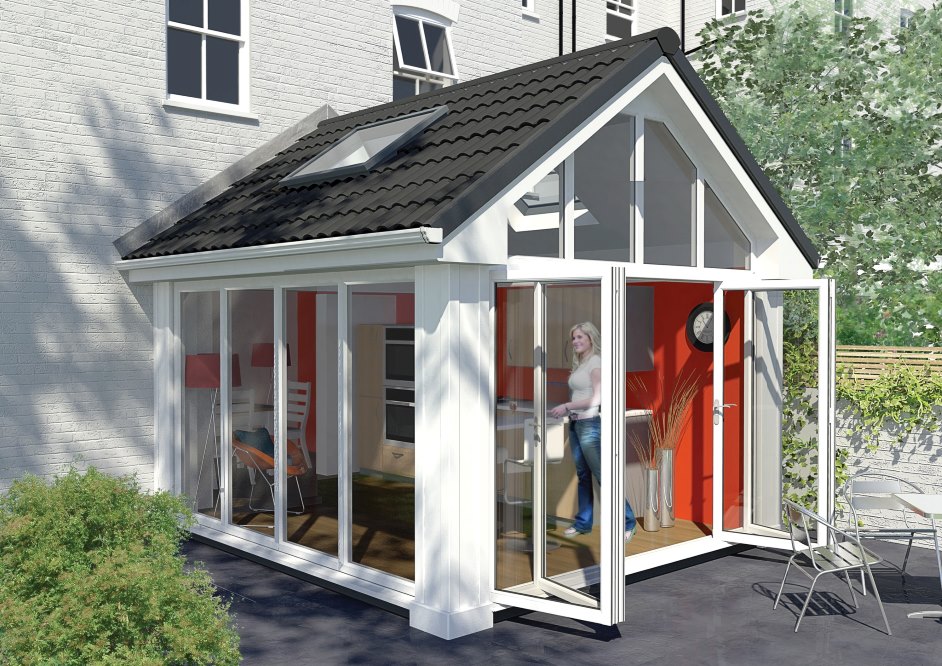
A gable-end conservatory is one of the strongest choices for a front-of-house position. It is a modification of the Edwardian design, replacing the hipped roof with a full ridge-height gable – giving a striking impression of extra space, height and light.
The vertical front roof forms a triangular gable end that creates a bold, symmetrical facade. From the street, this reads as a deliberate, architecturally confident addition rather than something bolted on as an afterthought.
Best for: Detached and semi-detached homes where the front elevation has enough width to accommodate a symmetrical design.
Victorian conservatories
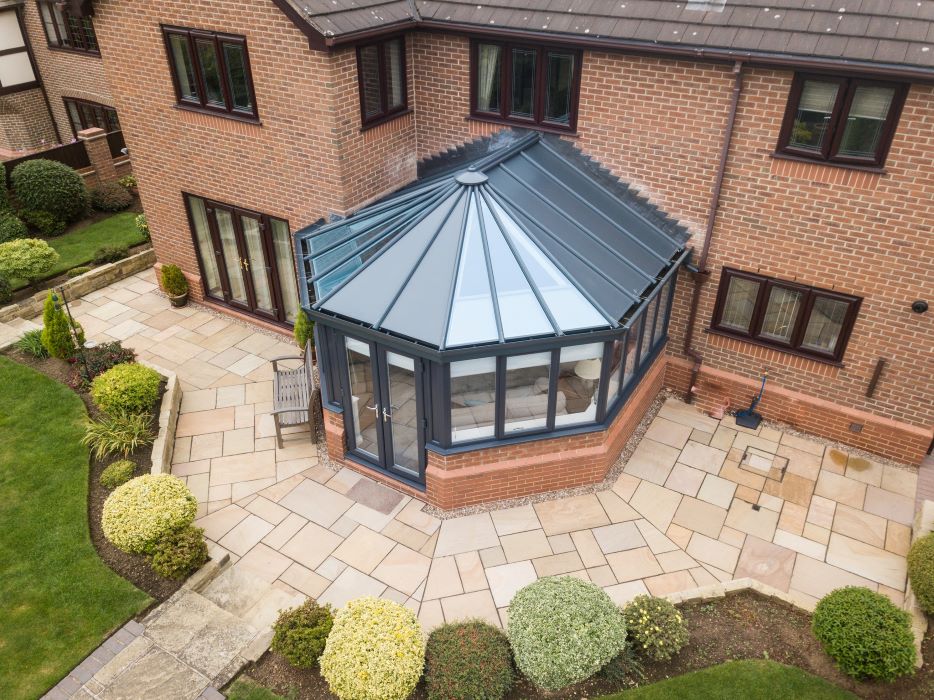
A Victorian conservatory brings distinctive bay fronts and ornate detailing to a front elevation. The three or five-faceted front creates a curved, rounded appearance that draws the eye. This style works particularly well on period properties but can complement a wide range of homes. The ornate ridge details and steeply pitched roof give it a strong street presence.
Best for: Period and traditional properties, or any home where character and kerb appeal are a priority.
Edwardian conservatories
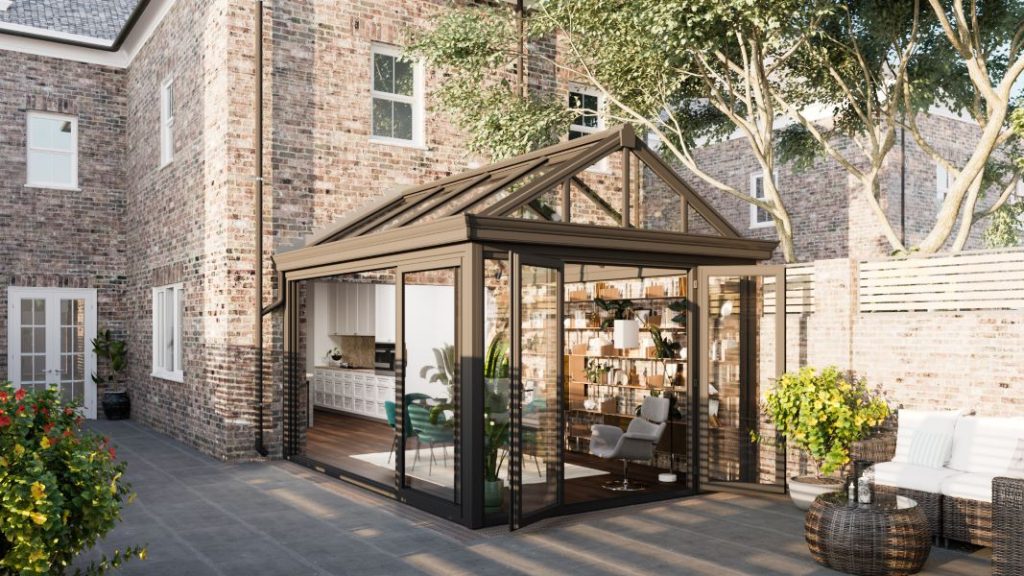
The Edwardian conservatory offers clean lines, square corners and a pitched roof – a timeless design that maximises usable floor space. Its simpler, more restrained profile can be easier to get planning approval for on a front elevation, as it tends to sit more neatly against the existing house without dominating the streetscape.
Best for: Modern and new-build homes, or where space needs to be maximised without an overtly decorative look.
What are the benefits of adding a conservatory to the front of your house?
Most homeowners think of conservatories as rear additions – so when it works, a front conservatory is genuinely distinctive. Here’s what it can offer:
- Kerb appeal and value. A well-designed front conservatory makes an immediate impression and can meaningfully add to your property’s value.
- A welcoming entrance space. Many front conservatories serve as a large, light-filled porch or transitional room – a smarter, more usable alternative to a standard hallway.
- Better natural light at the front of the house. Front-facing rooms often receive strong morning or afternoon light depending on aspect. A conservatory harnesses that.
- More usable living space without moving, extending, or significantly disrupting the existing layout of your home.
What else should you consider when planning a front conservatory?
- Your property type. Permitted development rights do not apply to flats, maisonettes, or listed buildings. If your home is within a conservation area or covered by an Article 4 Direction, additional restrictions will apply. Check with your local authority before doing anything else.
- Height and boundary rules. The highest part of your conservatory should not exceed the highest part of the original house’s roof. If the structure is within two metres of a boundary, the maximum height is usually capped at three metres.
- Design coherence. Planning officers will look carefully at whether a front conservatory sits naturally within the street scene. Matching brickwork, sympathetic roof materials and frame colours that complement the existing house all strengthen an application. At Enhance, we match your new conservatory to the brickwork and style of your existing property – so it looks as though it was always there.
- Lawful Development Certificates. Even where permitted development applies to other parts of your project, obtaining a Lawful Development Certificate from your local authority provides formal, written proof that your build is legal – which can be invaluable when you come to sell.
Talk to us about your front conservatory
If you’re looking at adding a conservatory to the front of your house in Newcastle, Sunderland, Durham, Gateshead, Northumberland or anywhere across the North East, our team can advise you on what is achievable before you commit to anything.
We offer a free, no-obligation design service where one of our experienced designers visits your home, assesses the space, and creates a design tailored to your property and your planning situation. All permissions, compliance and paperwork are handled by us – from the initial application through to your 10-year CPA-insured guarantee once the build is complete.
Get in touch with Enhance Conservatories to start the conversation.