

- 19 May 2026|
- Conservatories
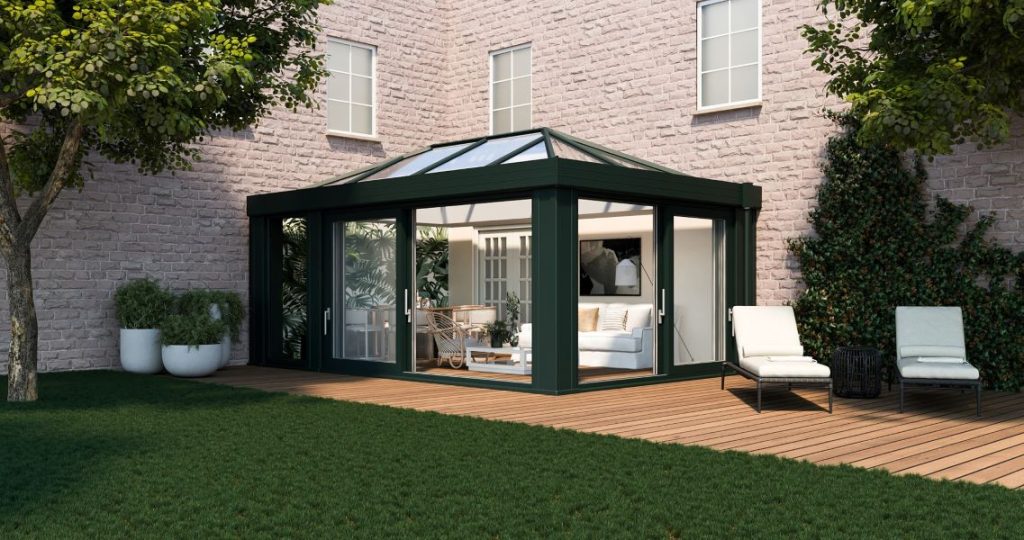
Most conservatories in England do not need planning permission. Under permitted development rights, you can build a single-storey rear conservatory without submitting a planning application – provided your property is a house (not a flat), and the build stays within set size, height and boundary limits. If your conservatory meets those rules, you can go ahead without any formal approval from your local council.
That said, the rules have layers, and where your home sits – whether it is detached, semi-detached or in a designated area – changes what you are permitted to build. This guide covers everything you need to know before you commit.
The most common reasons a conservatory will need planning permission
Your home is a listed building or in a conservation area, you want to exceed size limits, your permitted development rights have been removed by an Article 4 Direction, or the conservatory will be forward of the principal elevation facing a highway.
Permitted development rights for extensions do not apply to flats or maisonettes – only to houses. Planning permission is always required for these property types.
How large can a conservatory be without planning permission?
This is the question most homeowners ask first, and the answer depends on your house type.
The maximum depth for an attached house is 3 metres from the original rear wall, or 4 metres under the Larger Home Extension scheme. For a detached house, the limit is 4 metres from the original rear wall, or 8 metres under the Larger Home Extension scheme. The maximum height is 4 metres, or no higher than the existing eaves – whichever is lower.
| Property type | Standard PD depth | Larger Home Extension depth | Max height |
| Detached house | 4 metres | 8 metres | 4 metres |
| Semi-detached house | 3 metres | 6 metres | 4 metres |
| Terraced house | 3 metres | 6 metres | 4 metres |
| Flat or maisonette | Not permitted | Not permitted | N/A |
When is a conservatory covered by permitted development without planning permission?
Beyond size, your conservatory must meet several other conditions to qualify. All of the following must apply:
- It extends no more than 4 metres from the rear wall (detached houses) or 3 metres (semi-detached/terraced), has eaves no higher than 3 metres, and total extensions do not cover more than 50% of the garden.
- It is a single-storey structure at the rear of the property.
- If building on the side of your house, it must not be wider than half the width of the original house.
- Any design that includes a balcony, veranda or raised platform will require planning permission.
- The requirement for similar visual appearance does not apply to conservatories, so glazed structures are treated more flexibly on materials.
What about designated areas and listed buildings?
If your property is a listed building, or located in a conservation area or national park, you may need full planning permission, regardless of the size of the conservatory.
All external works on listed buildings require Listed Building Consent, and usually planning permission too – with no exceptions for size.
If you’re unsure whether your property sits within a designated area, your local planning authority can confirm this. Alternatively, the Planning Portal has an interactive guide that allows you to check your permitted development rights by project type.
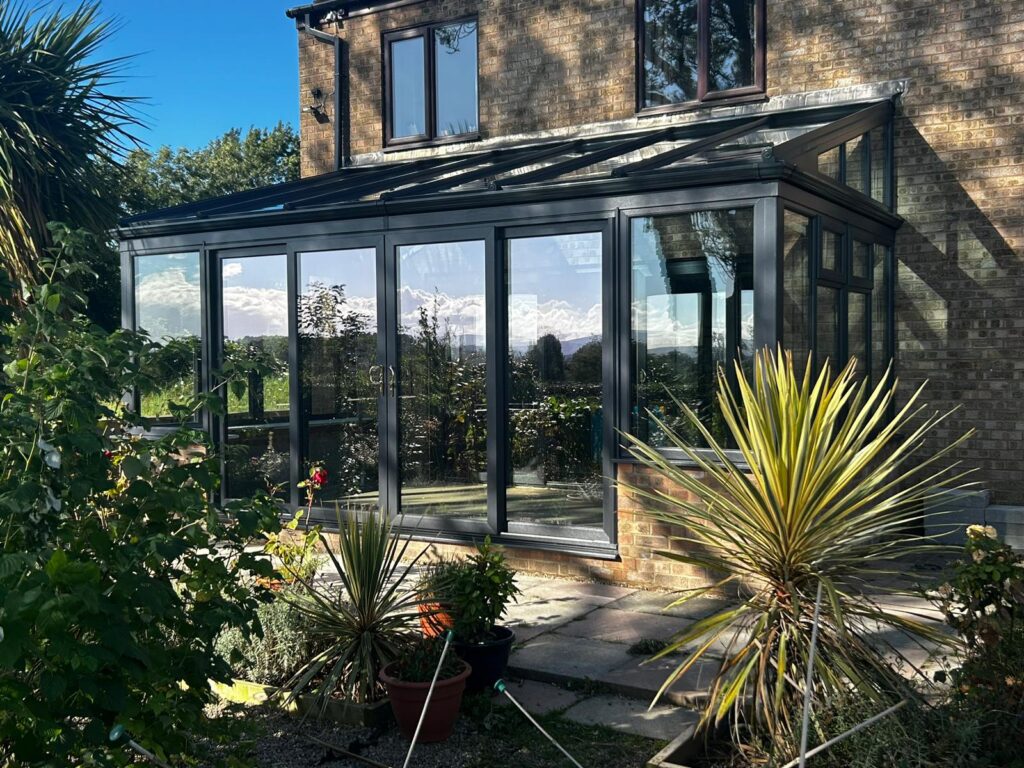
How Enhance Conservatories handles planning for you
Planning queries should not be a barrier to getting the extra space your home deserves.
Planning permission and building regulations can be a daunting process when you are looking to adapt your home – that’s why we take care of it all for you.
When you’re happy with your design, we draw up full architectural plans. We handle all the paperwork and compliance, from planning permission and building regulations, to water board approval.
With decades of experience in the home improvement industry, our team are specialists in conservatories, orangeries, and house extensions across the North East, from County Durham and Sunderland to Newcastle and Northumberland.
Whether you’re planning a traditional Victorian conservatory, a sleek modern glazed extension or a bespoke build designed around your property, we will confirm your permitted development position before a single brick is laid.
Book your free design consultation and let our team guide you through every step, from permitted development checks to the final installation.
Frequently asked questions
Do I need planning permission for a conservatory on a semi-detached house?
Not automatically. A conservatory on a semi-detached house qualifies as permitted development if it extends no more than 3 metres from the rear wall, has eaves no higher than 3 metres, and the total extensions do not cover more than 50% of the garden.
Does a conservatory need building regulations approval?
You can build a conservatory without building regulations approval if it is under 30m², separated from the house, and meets specific criteria. Open-plan layouts or those with extended central heating will likely require approval.
Can I build a conservatory right up to the fence?
If your conservatory is located within 2 metres of a boundary of your house, the eaves height of the conservatory cannot exceed 3 metres. Subject to that, you can build close to or up to a boundary, though the Party Wall Act may also apply.