

- 17 August 2026|
- Windows
If your timber sash window has become difficult to open, sticks partway, or won’t move at all, you’re facing a choice: repair it, or replace it.
Here at Enhance Conservatories, we don’t restore or repair timber sash windows; we replace them, with a uPVC sliding sash range built to match the traditional look. So you might reasonably ask why we’re writing a guide on how to make an old sash window slide more easily.
The answer’s simple: we’d rather give you an honest answer than sell you something before you’re ready for it. Below, we’ll walk through the genuine fixes that get a stiff sash moving again, when those fixes are worth your time, and the clear signs that tell you when a window has gone past the point where repair makes sense. And if you do reach that point, we’ll show you what a proper replacement actually looks like.
Read on for a full breakdown of every cause and cure, a cost comparison table, and a clear checklist that tells you which side of the line your window sits on.
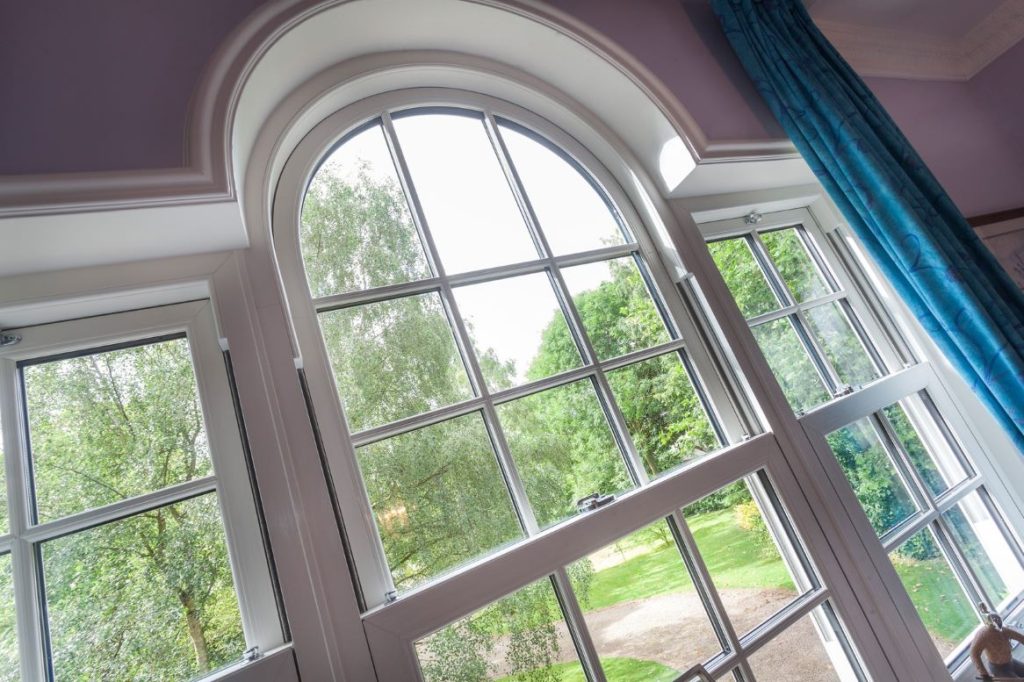
What makes a sash window stop sliding?
Traditional timber sash windows operate on a beautifully simple principle: two panels (the upper and lower sashes) slide vertically inside a box frame, counterbalanced by weights hidden in the frame cavity, or, in later windows, by spring balances.
When the window is new and well maintained, movement is effortless. When something in that system fails, the result ranges from slightly sticky to completely immovable.
There are five root causes behind virtually every stiff sash window:
- Paint build-up – decades of repainting gradually fuse the sash to the frame
- Timber swelling – moisture absorbed by the wood causes it to expand and bind
- Broken or frayed sash cords – the counterweight system collapses, making the sash feel impossibly heavy
- Worn or failed spiral balances – found in windows from the mid-20th century onwards, these lose tension and stop supporting the sash weight
- Accumulated dirt and debris in the runners – grit and grime create friction that grows worse each season
Understanding which of these is affecting your window determines whether a weekend DIY fix will do the job, or whether you are about to spend money on a repair that buys you a few years at best.
How to make sash windows slide more easily: The DIY fixes
1. Breaking a paint seal
This is the single most common reason for a seized lower sash, and it is almost always fixable without a tradesperson.
Over many years of repainting, the gap between the sash and the staff bead (the thin strip of timber that holds the sash in the frame) gets filled with paint. The window is effectively glued shut.
What to do:
- Run a sharp Stanley knife along the line where the sash meets the staff bead on both vertical sides and across the top of the lower sash
- Work the knife in carefully at several points, then gently lever the sash inward with a wide, flat putty knife
- Once the seal is broken, sand the contact edges lightly so the sash clears the bead cleanly
- Avoid forcing the sash – the glass can crack if you apply pressure unevenly
2. Sanding swollen timber
Wood expands when it absorbs moisture, affecting various areas including living rooms. A sash that slides freely in winter but binds in humid summer months is almost certainly suffering from seasonal swelling. This is a property of timber, not a defect.
What to do:
- Open the window as far as it will go, or remove the sash entirely by unscrewing the staff beads
- Identify the binding points – look for shiny, rubbed patches on the sash edges
- Sand those areas lightly with 80-grit sandpaper, working along the grain
- Re-prime and repaint immediately to seal the exposed wood against further moisture absorption
- Do not remove more material than necessary – a sash that rattles in winter is also a problem
3. Lubricating the channels
Even a well-fitting sash moves more easily with a little lubrication on the runners. This is also the fastest thing to try if the window is sticky rather than completely stuck. In addition, consider using a vacuum cleaner to remove any accumulated debris from the tracks.
4. Replacing broken sash cords
A broken sash cord is easy to spot: the lower sash drops to the sill with no resistance, or the upper sash falls when you try to open it. You may also hear the weight thudding inside the frame cavity.
Cord replacement is a moderately skilled DIY task. It takes a couple of hours per window and requires the right cord – traditionally a waxed cotton sash cord, available from most timber merchants.
The basic process:
- Remove the pocket piece (small panel in the lower window frame) to access the weight cavity.
- Lift out the lower sash and unhook the remaining cord
- Remove the pocket piece (small panel in the lower frame) to access the weight cavity
- Re-thread the new cord over the pulley, attach the weight, and knot or nail the cord to the sash groove
- Refit the sash, check it balances correctly, then replace the staff beads
If both cords are intact but one is fraying, replace both at the same time. The labour cost of going back in is the same regardless of how many you replace.
5. Adjusting or replacing spiral balances
Later-period sash windows, many built between the 1960s and 1990s, replaced traditional cord-and-weight systems with metal spiral balances fitted inside the frame. These are simpler to access but fail in a different way: the spring inside the balance loses tension over time, meaning the sash no longer stays open and becomes difficult to move.
Balance tension can sometimes be adjusted by winding the spiral rod, but in most cases the balance unit needs replacing entirely. Balances are sized by sash weight and window height, so you need to measure accurately before ordering a replacement.
If your window uses spiral balances, check whether parts are still available for your window model before committing to a repair. Some older balance types are no longer manufactured, which pushes the cost and complexity upward.
The real cost of staying with a stiff sash window
Beyond the direct repair costs, a window that does not slide properly has knock-on effects that are easy to underestimate:
- A window that sticks closed does not get opened. Rooms with poor ventilation accumulate moisture, which accelerates condensation, mould growth and the further deterioration of the window itself. This is particularly common in bedrooms and kitchens.
- Heat loss. A sash that binds in the open position does not close fully. A gap of even 2-3mm around a standard-size sash creates a real air infiltration path, particularly in exposed North East locations where prevailing winds are stronger. The Energy Saving Trust highlights draughts as a significant contributor to heat loss in older properties, with windows a primary source.
- A window that cannot be fully closed and latched is a security weakness. Many older sash window catches are also minimal, a rattling sash window is not difficult to force from outside.
- Property value. Visibly deteriorating windows are one of the first things a surveyor notes. Rotted cills, failed putty and stuck sashes all appear in condition reports, and buyers factor repair costs into offers.
Repair vs replace: A quick decision framework
Use this checklist to work out where your window sits.
Repair is likely the right call if:
- The box frame is structurally sound and square
- Any rot is localised to a single small area
- The cords or balances are the only mechanical failure
- The window has been maintained reasonably well in recent years
- You are in a conservation area or listed building where like-for-like replacement is required
Replacement makes more sense if:
- The frame is racked, rotten, or structurally compromised
- You have repaired the same window twice in the last decade and the problems keep returning
- Repair quotes exceed 50% of the cost of a new window
- Energy bills are high and the window provides little thermal resistance
- You want a permanent solution that requires no ongoing maintenance
A practical rule of thumb widely used by window specialists: if more than half the window needs replacing as part of a repair, you have already crossed the economic threshold where a new window is the better investment.
Replacing your timber sash windows with uPVC
If you have exhausted the repair options, or you simply want to improve your home, it may be time to consider a new sash window.
Timber sash windows have real charm, and they also have drawbacks that no amount of maintenance removes. The single glazing offers little thermal resistance. The paint needs refreshing every five to seven years. The cord-and-weight mechanism wears. The timber swells in damp weather and shrinks in dry weather, and over decades the frame itself moves with the building.
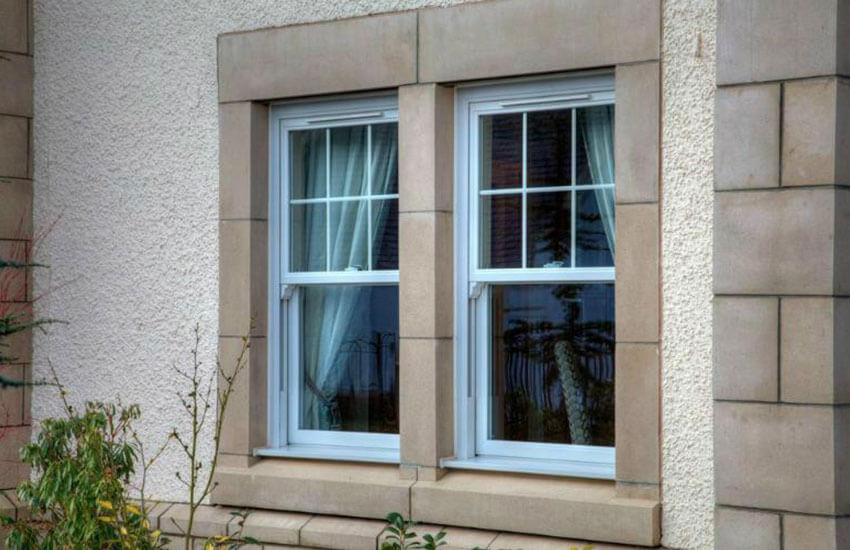
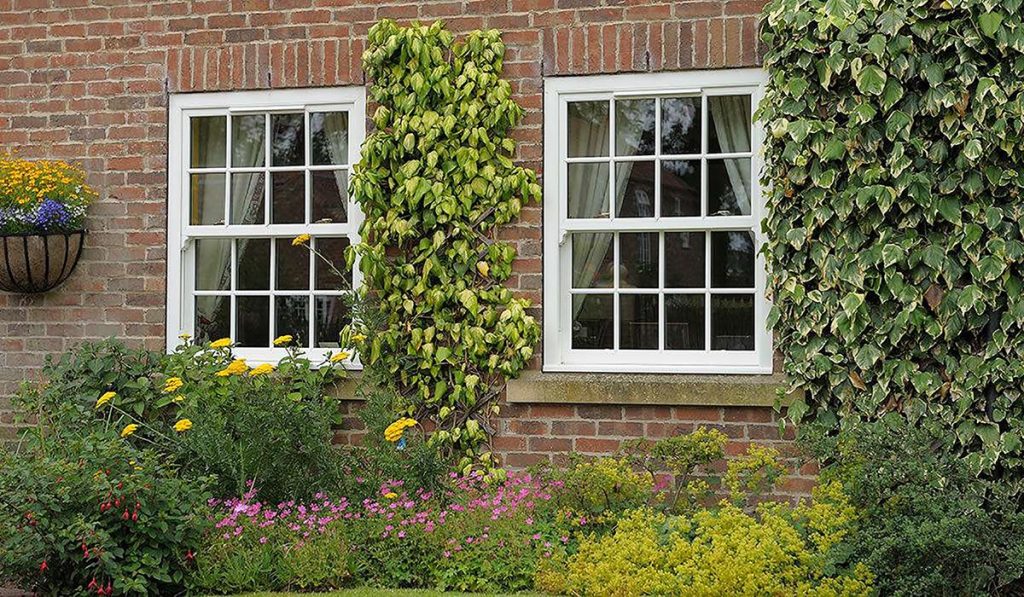
A modern uPVC sliding sash window replicates the traditional look while removing the maintenance. The vertical sliding action, the proportions, the deep bottom rail and the sash horns are all reproduced, so the window still reads correctly on a period property.
Behind that appearance, everything changes. The frames do not rot, swell, shrink or need painting. The glazing is factory-sealed and double glazed. The sliding mechanism is a modern spring balance system, sealed within the frame, that requires no maintenance under normal use.
Our uPVC sliding sash windows are ECOSlide windows, manufactured in Wales by Victorian Sliders, the largest manufacturer of uPVC vertical sliding sash windows in Europe. Each window is made bespoke to the opening.
The specification includes:
- Energy performance – A+ rated as standard, with U-values around 1.4 W/m²K, against the single-glazed performance of an original timber sash
- Security – PAS 24 certified
- Authentic detailing – Run-through sash horns, slim sightlines and deep bottom rails, with Georgian and astragal bar options
- Colour and finish – An extensive colour range, including heritage foil finishes that match or complement original painted timber rather than defaulting to white uPVC
- Guarantee – Backed by a 10-year guarantee
For a homeowner in a Victorian or Edwardian property, that combination matters. The window looks right from the street, and the annual paint-and-repair cycle ends.
Why choose Enhance for your sliding sash replacement?
Replacing a timber sash window is a more specialist undertaking than replacing a casement, and the difference is worth understanding.
An original timber box sash frame can be 100mm deep or more. A modern uPVC sliding sash frame is typically around 70mm. Once the old box frame is removed, that difference leaves a void around the new window which must be packed, insulated and finished correctly, internally and externally, so the window sits square, seals properly and looks as though it belongs in the opening.
Measurement is where the skill shows. Measured poorly, the result is a wide band of frame on show and a reduced glass area, which undermines the proportions of a period property. Measured properly, the new window reads as correct from the street.
The internal finish matters equally. Removing a full box frame affects the plaster, the reveals and often the decoration around the window, and making that good is part of the job rather than something left to the homeowner.
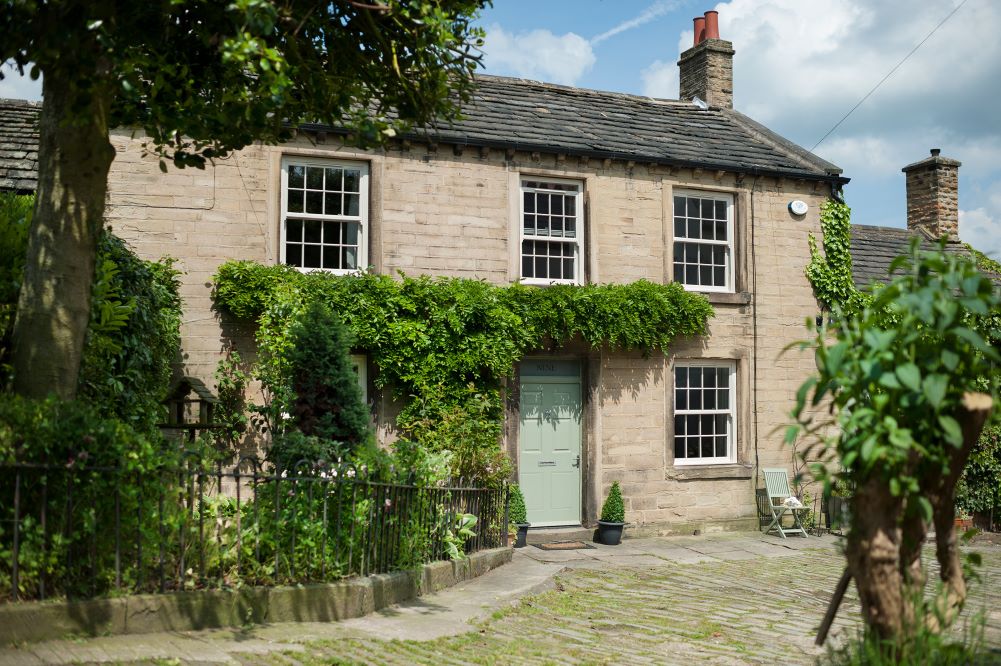
Sash windows on older North East properties are also rarely a simple rectangle in a flat wall. Bays, bows, arched heads, oversized openings and deep stone reveals each require accurate measurement, bespoke manufacture and skilled fitting. Our installation teams work across all of these configurations regularly.
Working with Enhance Conservatories
Ready to see what a proper sash window replacement looks like on your property? Get in touch with the team at Enhance Conservatories for a free, no-obligation quote. We’ll measure your existing openings, talk you through the ECOSlide range, and give you an honest view on whether replacement is the right move for your home – no pressure, no hard sell.
Call us on 0191 466 1666 or fill in our online enquiry form to book your survey today.